
It is of vital importance that Operators and Businesses understand their responsibilities when it comes to thorough examination, HSE make it very clear that machinery being used in a workplace needs to be safe for use and has to be inspected regularly.

HSE definition of the legal requirement
“Thorough examination of workplace machinery is required under health and safety law: LOLER 1998, which covers lifting equipment, and PUWER 1998, which deals with all other safety-related items, such as brakes, steering and tyres. Your regular inspections as part of a preventive maintenance scheme or scheduled service are not a thorough examination.”
I suppose the first question we should ask is what is a thorough examination?
A full thorough examination consists of meeting the requirements of both LOLER 1998 and PUWER 1998. They outline what is required for the testing of workplace machinery. LOLER and PUWER are both constantly being updated with the requirements; below is an extract from Regulation 6 of PUWER and Regulation 9 of LOLER.
Regulation 6 Inspection – PUWER 1998
“This new regulation covers the extent and nature of inspection. It formalises the practice of systematic in-house checks on work equipment that already exists in many organisations. The regulation focuses on:
- The different situations where inspection of work equipment is required.
- The purpose of the inspection in each case.
- Who carries out the inspections.
- Keeping records of inspection.
- Work equipment not covered by regulation 6.”
Regulation 9 Thorough Examination and inspection – LOLER 1998
“Regulation 9 concerns the thorough examination of lifting equipment: the detailed and specialised examination by a competent person. The examination required by this regulation is similar to thorough examinations required by previous sector specific legislation such as the Factories Act 1961. The regulation is in seven parts. Parts 1–4 contain the main provisions for the thorough examination of lifting equipment:
- Before it is put into service for the first time.
- After installation or reassembly.
- During its exposure to conditions which cause deterioration.
- AND of the requirement for evidence of the last such examination when the equipment is used outside the undertaking.
Parts 5–7 deal with exclusions and matters relating to previous regulations.”
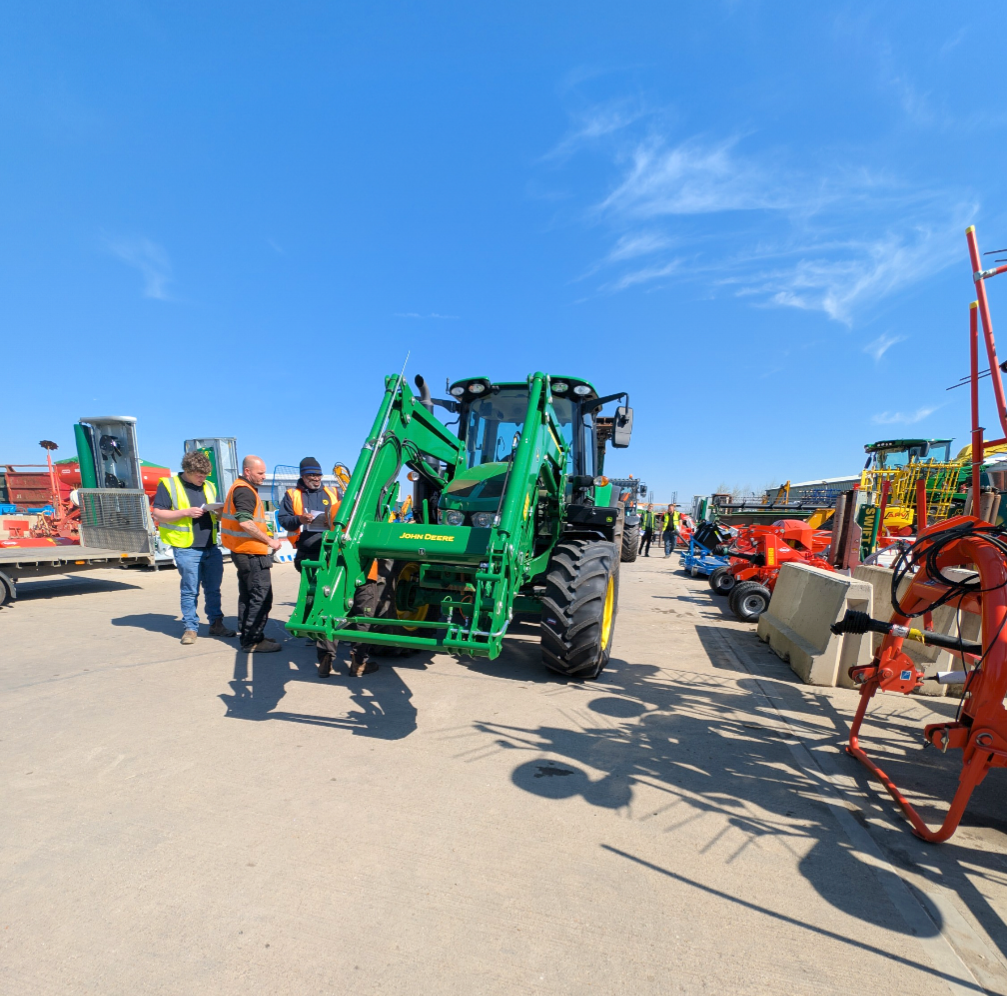
LOLER in agriculture
In agriculture, the term covers a wide range of equipment including:
Tractor foreloaders, fork-lift trucks and telescopic handlers (telehandlers); Workshop hoists and rope hoists; Cranes on machines (eg on lorries or fertiliser spreaders); and Lifting attachments and accessories.
Lifting equipment for lifting people
People should only be raised on work equipment which is specifically designed for that purpose but can, in exceptional circumstances be lifted by other machines provided that they have a purpose-made carrier, suitably constructed and attached – see HSE guidance PM28 – Non integrated platforms on lift trucks. Nobody should ever be lifted in a telehandler bucket, in a potato box, on the forks of a fork lift truck or similar attachment, to carry out work or used as a means of access e.g. to get onto the roof of a building or bale stack.
Thorough examination
Thorough examination of lifting equipment is to protect both operators and people in the vicinity of lifting operations who may be at risk if the equipment suddenly failed. Lifting equipment used to lift loads will require a thorough examination by a competent person. This includes but is not limited to telehandlers, fork-lift trucks, MEWPs and fore-loaders.
Competent persons
Where lifting equipment requires a thorough examination, you will need to arrange for this to be carried out by a competent person. This will normally be an independent person, such as an engineer, who has the necessary knowledge, experience and training of the lifting equipment concerned to enable them to detect any defects.
Who is responsible for work equipment?
It is the responsibility of the employer to make sure workplace machinery is safe and that all rules are being abided by including those of your employees.
Some important points to consider as an employer are:
- Those hiring out equipment for use at work are considered as suppliers under section 6 of the Health and Safety at Work Act and so have broad responsibilities for the safety of the products they hire out. This includes (so far as reasonably practicable) pre-hire testing and inspection to ensure continued safety, and the provision of information.
- Those hiring out work equipment also have responsibilities under PUWER and if lifting equipment LOLER, in so far as they exercise control over that equipment (for example, ensuring the thorough examination of lifting equipment and other routine inspections have taken place at the required intervals).
- It may be appropriate for the user to organise the periodic thorough examinations (which should be by written agreement, particularly for long-term hire). However, unless part of the hire agreement, those hiring out work equipment can’t normally be responsible for the day-to-day and other pre-use safety checks which should be undertaken by the user.
- The implications of not following LOLER and PUWER regulations could result in HSE Audits, Large fines, Prosecution, Accidents, Fatal Injuries.
Click here for HSE statistics, which you could say could have been reduced or stopped if the rules were being followed and all involved had been safe.
To book BAGMA’s Thorough Examination Training please get in touch with Kari Hearn via info@bagma.com 07874 876999
