
We all know too well the high levels of stress in our everyday life. We appreciate how it can negatively affect everyone’s well-being and ultimately our performance. The benefits of being able to identify ‘stress signs’ and knowing what to do, to build resilience, can be immeasurable. Phil Helmn of the Bernhard Academy offers some insight and advice.
Defining stress isn’t easy. Professionals who’ve spent most of their lives studying stress still have trouble defining the condition. Indeed, it is much like trying to define happiness – everyone knows what it is, but no one can agree on a single definition!
Is all stress bad?
Historically, stress is usually discussed as a health risk. But not all stress is bad. In fact, there is a point in which stress can produce some of our best work. Sure, we have all experienced some form of ‘nerves’ before an important activity such as a presentation or meeting. We now understand that this is simply our bodies producing a little more adrenaline to help us cope, creating what is known as ‘optimal stress.’ ‘Good stress,’ or what psychologists refer to as ‘eustress’, is the type of stress we feel when we are excited. It is the point at which stress is intense enough to motivate and physically prepare us to perform optimally, yet not intense enough to cause the body harmful effects.
The biology bit.
Whenever we feel stressed, our bodies produce two hormones – adrenaline and cortisol. When this happens, it is this chemical imbalance within our body which affects our physical and/or our mental state. Essentially, the problems arise when our stress responses, which are supposed to help alert us to danger and help us avoid harm, are not needed for the trigger we face! Adrenaline prepares our bodies to fight or flee, but what about when you’re faced with a problem that physically running away isn’t going to help? This physical action would not help us positively resolve a difficult committee meeting for example.
If you are mentally stressed, you might feel:
- Irritable, angry, impatient or wound up
- Racing thoughts and an inability to switch off
- Like you’ve lost your sense of humour
The hormones that our bodies produce to respond to stressful situations can have many physical effects. These effects might include:
- Sleep problems
- Muscle aches and headaches
- Chest pains and high blood pressure
Monitoring and measuring stress.
Self-monitoring is the ability to see and evaluate your own emotions, thoughts and behaviours in different situations. Self-monitoring can help our career, our well-being and our relationships with colleagues and can help us enhance our performance at work. Having our own ‘stress meter’ can help us gauge how we are feeling and when we feel action is needed for our own well-being.
Stress Meter (Karl Rollinson 2018)
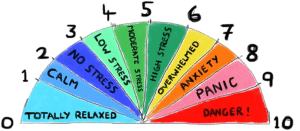
By being aware of our emotions, we can also prevent them from interfering with our decision-making, problem-solving and communication skills. By understanding how we come across to others, we can avoid misunderstandings, conflicts and negative impressions. It is widely recognised that stress is related to two factors:
- Stress triggers: The factors that cause stress
- Stress responses: How you react to stress
Techniques for lowering mental and physical stress responses.
Taking control of our stress and actively engaging in our fight to reduce our stress levels is the first step to improving our well-being. If we believe that we can’t do anything about our problem, our stress can get worse. That feeling of loss of control is one of the main causes of stress and so positive action is a crucial step towards self-empowerment. A particularly effective stress management model to help in stress reduction is adopting the four A’s of stress management, which helps to identify different approaches to managing triggers and how to react in more productive ways.

The four A’s stress management model (Dr Albert Ellis 1950)
The art of resilience.
Unfortunately, we’re not born with resilience, but we can build resilience over time. Like most things, to get better, we must practice it by changing our habits and behaviours through mental and emotional flexibility. Try building the following self-care tips into your daily routine, as regularly doing them can make an enormous difference in lowering stress and raising resilience:
- Minimise phone use and screen time (turn off notifications)
- Understand your triggers
- Avoid procrastination
- Learn to say ‘no’
- Look at the bigger picture
- Get the right amount of sleep
- Take a break in nature or your favourite place
- Reduce your caffeine intake
- Spend time with friends and family who nurture you
- Eat well balanced meals
- Exercise
Adaptation syndrome theory on mental health (Hans Selye 1936).
In conclusion, prioritising mental well-being is essential for leading a fulfilling life. By nurturing our minds with compassion, understanding and self-care, we empower ourselves to face challenges with resilience and grace. Let us embrace a kinder approach towards our mental health, fostering growth, joy, and balance in every aspect of our lives.
About the Bernhard Academy
At The Bernhard Academy, our mission is to support and advance the industry by providing training and development opportunities for individuals at all stage of their career. Offering a comprehensive portfolio of pathways, courses and initiatives, designed to foster continuing personal and professional development, to enhance skills, knowledge, and expertise to ensure that everyone can thrive and excel.
For more information, visit www.bernhardacademy.co.uk
